Search

Happy. Healthy. Heathen.

Traveling, training, thinking, talking, typing

Paleo post, part 5

In continuing our title alliteration, this is the Protein Post.

There are 3 types of nutrients we eat:  carbohydrates, fat, and protein.  We’ve already covered most carbohydrates, we haven’t yet discussed fat, and now we look at protein.

images-1

Protein by definition is any of a class of nitrogenous organic compounds that consist of large molecules composed of one or more long chains of amino acids and are an essential part of all living organisms, esp. as structural components of body tissues such as muscle, hair, collagen, etc., and as enzymes and antibodies.  What that means to us is that because protein is found everywhere in our bodies, we need nutritional protein to survive.  Protein is found in animal products (muscle meat, organs, dairy, eggs,), in beans, nuts, seeds, tofu, and some grains (quinoa).

The focus of this post is to discuss the best sources of animal protein, and is not the debate about eating animal protein at all.  That’s an important and interesting and relevant topic that I promise to blog about at another time.

It has been said that You Are What You Eat.  Michael Pollan, the author of Omnivore’s Dilemma, takes that one step further and says: You Are What You Eat Eats.  So there is a point to be made that all that corn and grain our commercial livestock are being fed are showing up on our table after all.  And if we’re trying to eliminate that, we’ve just had a huge setback.

But there’s so much more important a reason not to eat grainfed meat (I’m talking about ungulates now – cows, pigs, sheep).  These animals have not evolved to eat grain in the manner that our American meat industry feeds them grain.  It makes them sick, and necessitates their being on antibiotics most of the time they are being fed grain.  Grain causes rapid weight gain, which of course increases profits, but puts the animal in an extremely unhealthy condition.  And of course, all this unnatural food that makes them sick causes them to suffer.  As much of an advocate of health I am, this suffering should be a much greater motivator than our personal health.  If we are going to eat meat, finding animals humanely raised, humanely slaughtered, and naturally fed should be a goal all of us should strive for.  The fact that they make us healthier should be a secondary concern.  The book I mentioned above, Omnivore’s Dilemma, is one of the best resources for becoming educated about the status of this portion of our food supply.

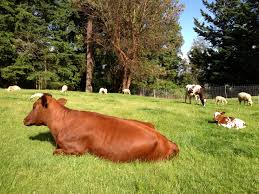
Because so many folks have found better health through a more natural approach to eating, it is likely that you can find a supplier of grass-fed, humanely-raised, local, pastured animals.  Whole Foods tries to use local suppliers, and uses a number grade to reflect sustainability.  Hit up your local farmers’ market – even rural Murfreesboro has 2 grass-fed animal farmers, who provide both beef and pork.  You can also easily find pastured chickens’ eggs, since even back-yard chicken farms produce an abundance of fresh eggs.  Or you could investigate the wonderful world of raising hens yourself!  They cut down on the bug population, they aerate the grass, they provide eggs, and if you don’t get Foghorn Leghorn they’re not really noisy – just a little proud clucking when one lays an egg.
images-2

Wild game is a good choice too, as are wild-caught fish and seafood.  Contrary to most folks’ perception of Paleo, it’s really not massive amounts of protein.  Today I had one 6-ounce piece of tuna, and a couple of eggs – the rest was fat and vegetables.  Some days I have a little more, most days about 60-80 grams of protein.

In the next post, when we discuss healthy fats, we’ll also address the importance of pastured animals.  When I first began to eat this way, I considered this a 2nd or 3rd tier issue – if I’m eating good protein, eliminating grains and sugar, eating my vegetables, do I really have to go to the effort of finding and buying grass-fed meat??  I’ve come to the conclusion I was wrong about that.  I think this is a high priority for our health, for reasons we’ll get to in the next post!

Thanks for reading!

Paleo Post, part 4

The Dairy post.

Full disclosure:  except for limiting alcohol, this is the food I miss the most, and is the one in which I am most likely to indulge.

Dairy is made up of some of the same amino acids that are found in the muscle meat of the cow, but there are milk proteins that may cause damage to our intestinal lining.  Milk products, whether human or cow (or goat or sheep) are critically important to the development of an infant of that species.  Milk comes packed with good immune and hormone messages that direct the rapid growth and nutrient capture in those infants.

However, children and other mammals soon lose the enzymes to digest milk not long after they are weaned.  Lactose intolerance is very common because our bodies simply don’t need it after about 2 years after our birth.  If we keep consuming milk and milk products, because we are not efficient at digesting it without lactose, it creates yucky intestinal problems like bloating and gas.  There is also a condition known as Leaky Gut Syndrome, where because of chronic inflammation (our old enemy), the lining of the small intestine has lost some of its integrity, and molecules that could not pass through the lining of a healthy intestine, permeate and go places where they can create problems.  Milk proteins could be potentially be implicated in contributing to this syndrome.

What about calcium?  See what years of marketing has done to us?  It’s the first question I’m asked if I say that I don’t eat dairy.  Calcium is important for bone growth, and muscle contraction, but just like everything else I’ve been writing about, it’s not as simple as Eat Calcium (From Milk) For Strong Bones.

A) Strong bones don’t depend just on calcium to be strong.  Guess what else makes strong bones?  Lifting heavy things.  In a study of obese adults, their markers for health were worse than a non-obese person in every matrix that could be measured except for one:  Bone Density.  Bones in obese adults are thick and strong, because the repeated pressure on those bones have demanded it.

B) Dairy is not the only source of calcium.  In fact, it’s not even the best source of calcium.  Guess what else has calcium, that is more accessible than the calcium in milk?  Green vegetables!  Leafies like kale and spinach and mustard greens have calcium, as does meat and seafood, and even nuts!  And they come without the baggage of the milk proteins that can cause the damage.

I’m planning an entire post about how I manage “nutritional offroading” but I’ll say here that if you have a healthy immune system, and a healthy gut, and all of your visible, perceivable, and testable markers for health are in the good zone, you can probably occasionally ingest some cheese or cream or butter from pastured animals and suffer no lasting ill effects.  Dairy does have some good saturated fat, and those amino acids I mentioned earlier, so there is at least some good going in with the bad (unlike grains which have nothing good to offer).

I also am planning to address how to approach all of these rules to integrate them into your life, whether to go all in or take up one rule at a time.  When we get to that, I’ll explain what I’d suggest (and what I did) with dairy, and all the other food groups, to determine if dairy is problematic for you.  I can tell you what the science says about it generally, and how we go about using self-experimentation.

I think I have written this post and the next post (pastured meats) out of sequence.  It’s important to understand how ruminants’ (cows and goats and sheep) digestive systems work, and why they should be pastured, to understand how their milk and meat are affected.  So come back and read this one after the next post on Eating Meat.

Thanks for reading!

Paleo post, part 3

Today is the vegetable post.

Eat them.

Thanks for reading!


OK, I’ve already covered the hardest part – the No Grains and No Sugar part.  This next one is an affirmative rule, and it’s one you can learn to love.

We should eat vegetables every day.  Lots of them.  Lots of different kinds of them.  You already know they are loaded with good stuff – nutrients, vitamins, phytonutrients, minerals.  There is research showing that vegetables with their phytochemicals can be helpful in fighting cancer.

Additionally, there are SO MANY different kinds of vegetables, which becomes important when you eliminate grains and sugar as a way to keep your food interesting and new.  There are only a few types of animals we eat, and because the Standard American Diet (aptly abbreviated to SAD) is so full of grain-based foods, if you do make a transition to a more traditional diet, you are likely to experience a feeling of depravity, and all those veggie varieties can help with that.

imagesimages-1So whether you have a big salad of fresh vegetables, or a stew or stirfry full of cooked vegetables, shoot for having them at 2 meals out of 3, or maybe start with one big meal of non-starchy veggies every day.

And I have good news about your next question.  While we’re ditching the croutons and shredded cheddar cheese, we’re adding good fats so you can have some kickass dressing on that big ol’ salad.  Here’s a recipe for homemade mayo (stay away from the ooky grocery store stuff) that can serve as a base for scads of dressings.  I make you a personal promise that it will be the tastiest mayo you have ever tried.

You can also add olives, nuts, chopped boiled eggs, a protein, and even fruit.  You may, like me, find that your salad meal is your favorite meal of the day.

For your cooked vegetables, try roasting almost any vegetable for the best flavor (400 degrees, one layer deep and tossed with sea salt and olive oil, 12-25 minutes depending upon size of pieces).  This gives broccoli, asparagus, kale, squash, brussel sprouts, and zucchini a crunchy, roasty flavor.  Another personal promise that you’re gonna LOVE this.

Fruits can also be a part of a healthy paleo diet.  I’m going to address this further in the post about Fat (to come).  Some fruits are high in sugar (bananas, apples), and you remember from the Sugar post that this can create a problem if we eat too much.  But Gayle, you rightly ask, how does that fit with the whole Paleo mentality?  Aren’t we supposed to be eating similar to our ancestors, and wouldn’t they have eaten fruit?  Why yes, they would – when they could get it, which would be when?  Seasonally.  (Just like veggies, by the way).  And the fruit that would have been available would not even have resembled a big juicy Red Delicious.  Finally, remember that we are building a diet that is healthy, not just historic, and too much sugar, from any source, leads to an insulin response.  Get to know the sugar content of fruits (and vegetables), and eat them as toppings, or see them as they treat they are.

Probably everyone has heard the analysis of whether or not to spend the extra for the Organic label – that if you are going to peel it (bananas or pineapples), non-organic is suitable; for leafies or veggies that are hard to wash, or whose peel you plan to eat (spinach, lettuces, sweet potatoes), go ahead and spend the extra.  Here’s my thought on the Organic issue:  I consider this issue to be about Tier 3 or 4 as it relates to priority.  If you’ve taken grains out of your diet, eliminated dairy, if you’re eating grass-fed meats and quality fats, THEN worry about whether or not your strawberries are organic.

I think a better focus is to seek LOCAL sources for your fruits and vegetables for at least 3 reasons – it supports local farmers and not superstores, it reduces the energy cost and carbon impact of transporting food from sometimes thousands of miles away (banana, anyone?), and the produce does not have to be genetically engineered to survive the journey and handling it takes to get to you.

By the way, corn is a grain, not a vegetable.  Beans are legumes, not vegetables.  A potato, while botanically a vegetable, is nutritionally a starchy tuber.

One more time I’ll state my disclaimer – this information I’m sharing is what I accept about nutrition science, and it matches pretty squarely with my own experience with my own health and nutrition.  This might be a good time for me to post this link which addresses the book The China Study, whose claims contradict Paleolithic nutrition science.  Denise Minger is a rockstar in the movement – here is her 2012 presentation at the Ancestral Health Symposium.

Next up:  Dairy!  One of the hottest topics within the Ancestral Health movement.

Thanks for reading!


Paleo Post, Part 2

So we covered grains and their inflammatory effects.

Today’s topic is Sugar, in all of its non-grain forms.  Brown sugar, white sugar, honey, agave, maple syrup, AND artificial sweeteners, all of them, that I don’t need to name.

But before I get into that, let me issue another disclaimer about all this.

I blog because I like to, because it lets me organize my own thoughts, and because enough people ask me to focus on a certain topic.  If you are reading this, thank you.  But in this area, unlike my secular posts, these posts are not written to convince you.  I am not knowledgeable in this area, not enough to be a valid source of information.  This series of posts is written to explain what works for me.  I am easily convinced that, in the area of nutrition, there is more than one way to skin that proverbial cat (gotta come up with a replacement for that horrible idiom).

So here’s the disclaimer:  if what you are doing, nutrition-wise, is working for you, continue to do that!  And by “work for you” I mean so many more things than just weight; there are markers for health that include answers to the questions How are you sleeping, and How are you feeling, and How are your bowels, and How is your sex drive, and How is your appetite?  If you’re not happy with the answers to those questions, then maybe you’ll have an good experience with the Paleo concept. In addition to those self-check questions, there are tests your physician can do including triglycerides, cholesterol, blood pressure that are probably more related to our overall health than our size and weight.

Back to sugar.  Here is a link I read just today, that is more on inflammation from the first post, but it applies to the inflammation caused by sugar as well as grains.  He gets into fats a little, which is a later post, but his description of the effects of the inflammatory process is powerful.

Even nutrition scientists who don’t embrace Paleo agree on the sequence that occurs when sugar, in all its forms, enter the body (here’s a pretty sciency explanation).  When my mother was diagnosed with diabetes 5 years ago, I wanted to make sure she understood the disease so she could be better equipped to make the best decisions for treatment.  I asked her what diabetes was, and her answer was that her pancreas was not functioning correctly.  To the contrary, I told her, your pancreas is functioning exactly as it should – it’s responding to the sugar in your bloodstream, and it’s working as hard as it can.  And that’s just the problem – we’re overworking that poor little organ, and our cells get insensitive to getting the message to DO SOMETHING WITH THE EXTRA SUGAR!  Insulin is a fat storage hormone, because the sugar has to go somewhere – it can’t stay in the bloodstream, so into the fat cells it goes to be used later.  Over and over and over, every time we put in sugar (whether it’s in the form of cakes, cookies, pasta, pretzels, pancakes, popsicles, or bagels).

A secondary effect is that when we get on the blood sugar roller coaster, when we hit those lows, we know, even subconsciously, that the way out of the low is the big hit of sugar.  There’s even evidence that artificial sweeteners, while they don’t have the same impact, because of their sweetness cause even a saliva response that  begins an insulin response.  Health experts even throw around the word addiction, although I don’t know enough about that phenomenon to know if our love of sugar qualifies.

And sugar is everywhere.  Check the labels of products in your pantry, and look for sugar words like corn syrup, fructose, sucrose, cane sugar, and molasses.  It’s relatively easy to refrain from adding extra table sugar to foods we eat, but it’s not so easy to avoid it in packaged products.  So the Paleo position is to stay away from any pre-packaged, processed food items.

Sugar in fruit:  yes, there is sugar in fruit, and there is also sugar in vegetables, some are even high in sugar.  I will touch on this again when I write the post on healthy fat, because it will factor in again there.  Until then, the general thought is to limit even fruit, especially those fruits high in sugar.  Melons and berries are good choices, and you will be surprised at how sweet all fruit is when sugar is removed from your diet.

Next post:  Vegetables!

Thanks for reading!


Paleo Post, part 1

I’m still in Vegas with my girlio, helping her apartment and job hunt.  The mini-update is:  it looks as if we have found her an apartment.  It’s about 5 miles from the strip, is gated and secure, and we should get her moved in tomorrow or Tuesday.  She’s begun the job application process by getting her Alcohol Card and Health Card, and all of the online applications filled out.  She’s optimistic about getting work, and is really excited about getting settled into her little Vegas home!

However, I want to post today about nutrition.  I’ve gotten a lot of response from folks since I posted about our experience with the Ancestral Health Symposium.  A lot of the response has been from my friends in the skeptic community.  I’m going to try to explain my position on this a little better, but it makes me so proud to be part of this group of skeptics who don’t accept information without evidence.

First, let’s work on the word.  The issue over the word “Paleo” reminds me of the flame wars the secular community has over the word “atheist” versus “any-self-identification-word-other-than-atheist” (agnostic, freethinker, humanist).  So many arguments against “Paleo” nutrition focus on this one word.  These arguments make a valid point.  I have a Portuguese friend who says that rules are divided into Theory and Practice (with his lovely accent those words are Teeory and Prrrractice).

In Theory, Paleo nutrition is a way of eating (and movement, and other things but we’ll focus first on nutrition) that is based on what we know about  human evolution.  There’s even an effort within the community to switch to the term Evolutionary Nutrition.  The theory is that we base our eating on the way of eating that allowed our ancestors to have survived to reproduce and thrive.  Paleo refers to the era when our ancestors were hunter-gatherers, before the Neolithic era of agriculture (Jared Diamond’s book Guns, Germs, and Steel, is an awesome book (and Pulitzer Prize winner) that explains the history of human societies).

However, in Practice, almost nothing we eat modernly is the same food our ancestors ate.  Not the bananas, not the brazil nuts, not the beasts.  Unless you are harvesting wild mushrooms, or fishing pristine rivers, or hunting wildebeests, you are eating modern versions of all of those ancient foods.  So I will agree with the “Paleo-busters” who assert that there can be no true Paleo diet because there is not true Paleo food.

There is a large part of this movement (and I don’t speak for anyone but myself) which is attempting to shift the focus from selecting our diet based solely on our ancestral heritage and more on what the food actually does when it enters your body.  In studying the effects these different nutrients (fat, protein, carbohydrates) have on our bodies, it’s helpful to have a basic understanding of human physiology and anatomy, and how our systems function separately and in harmony.

You remember from high school biology that we have cells –> organs –> systems.  Remember that we have 10 systems:  respiratory, musculoskeletal, nervous, reproductive, gastrointestinal, integumentary, urinary, immune, endocrine, and circulatory.  Each system is dependent upon the others, and the general health of the person is an accumulation of the health of each of the systems.  The things we do with and put into our body affect the systems, and therefore the whole body.

The process of figuring out what different foods do in the body is a challenging task, because of the interconnectedness of all the systems and the unique physiology of each person.  I have no scientific background, but even as a layperson I have found sufficient research to show that certain foods have a MORE healthy effect on the systems and certain foods have a LESS healthy effect.

So now here’s the rub.  What is healthy and what is unhealthy?  This is where the strength of skepticism comes in.  Conventional wisdom has always been a big red flag for me, and never more so than in what is considered a healthy diet.  Leaving aside for a moment that the government that provided us with the food guide pyramid is the same government that subsidizes corn, sugar, and soybeans to the tune of billions of dollars a year, let’s first look at the standard American diet with a critical eye:  assuming that the average grocery store reflects what the average American eats, 75% of the items in a grocery store contain corn or a corn product.  Even the beef, pork, and chicken from the grocery store are ultimately corn, as they are fed corn for all or most of their lives.  In his pivotal book, Omnivore’s Dilemma, Michael Pollan describes the history of the plant we know as corn, and how our industrial food supply is so dependent upon it, and how very unhealthy it is for humans, and the animals we eat, and humans again when we eat those animals.

Additionally, there is enough evidence to convince me that grains are inflammatory.  Inflammation, in turn, is very damaging to our body (also here) (and here).  There is a also syndrome known as leaky gut syndrome that results in increased intestinal permeability, and it is thought that grains contribute to this, which in turn leads to bad stuff getting into one’s bloodstream.  Finally, there’s some research that suggests that processed carbohydrates can light up pleasure centers in our brain so strongly that it mimics an addiction for some people.

This post is going far longer than I intended, so I’m going to have to break it into several posts.  I’m going to do it this way.  In summary of what I’ve said so far, there are several components of what the Ancestral Health movement endorses.  Over the next few posts, I’m going to personalize those factors according to what I think are the most important.  In the movement we call this N=1, and there is huge focus in the movement on self-experimenting.  This is because each of us has in our past a heritage based on climate and geography and the food that would have been available to our ancestors, and the digestive enzymes we would have evolved to accommodate that supply.

Here’s Gayle’s short version of How To Eat:

1.  Eliminate grains, whole or processed.

2.  Eliminate sugar.

3.  Eat lots and lots of a variety of vegetables, particularly the green leafy kind, and a limited amount of low-sugar fruit.

4.  Eliminate dairy.

5.  Eat meat from grass-fed cows, pastured pigs, free range chickens and eggs, and wild-caught fish.

6.  Eat healthy fat in the form of avocados, nuts, coconut, and olive oil.


While I’m working through all this, I may decide to change the sequence, or add to, the above list.  Also, this is only the NUTRITIONAL arena of the Paleo movement, which is only a portion of what contributes to our overall health.  So much more to come!

Thanks for reading!


We made it!

Here we are!  1880 miles and 3 days later, we’re here!

We started out in Albuquerque and this morning did not even have to backtrack to get to a Starbucks!  We started (and ended) the day out like we have the other 2 mornings:  listening to the Money song by the OJays.  Then it was back to her Vegas mix.

Today was a huge variety of landscapes and vistas.  In particular, we had no idea that Flagstaff, Arizona was a little ski town.  We’d been driving along in scenery that was expected from the southwest, and suddenly we drove through a green, forested, mountainous section.  We checked the GPS a couple of times and kept on driving.

Colorado, right in the middle of Arizona!

As soon as we crossed into Nevada, we got to stop and see the Hoover Dam.  There’s a reason it’s the touristy, obligatory thing to do.  Glenda gave me a primer on the whole art deco movement of the era while we took in the mindblowing engineering that the dam was and is.

IMG_1548

IMG_1562

IMG_1553

IMG_1555

Here are a few interesting sights we saw along the way today

If you are going to panhandle outside starbucks, you might not want to wear this shirt
This was special
This was special

Then we finally rounded the bend…

It's hard to see, but that's Vegas!
It’s hard to see, but that’s Vegas!

Instead of staying in a La Quinta out on the edge of town while we do our apartment hunting, my darling squeeze surprised us with reservations at the LVH!

Glenda’s excited and nervous and happy to be here.  Mrs. Whiskers was a trouper, and hasn’t had much to say about being a Las Vegas kitty.  Watch here for an update on apartment and job hunting.

Thanks for reading!


800 miles in a car with a cat.

This will be a quick recap, since it’s after midnight, and we’ve got another long day tomorrow.

Today’s states were Arkansas, Oklahoma, Texas, and New Mexico.  I think it was about 800 miles!

Here are the highlight pics:

How NOT to smuggle in a kitty
This is a real restaurant in Arkansas
...and in the parking lot of the Chair Crushers restaurant was the Feed The Children trailer.
…and in the parking lot of the Chair Crushers restaurant was the Feed The Children trailer.
Our feline passenger today

A better recap tomorrow, I promise!  Looks like about 575 more miles to Sin City.

Thanks for reading!


Deja vu all over again

For the second time in 4 months, I’m driving with a daughter, all of her belongings packed in her car, going west to start her post-college-graduation life.

That’s the fun of twinsies!

Off we go!  This time it’s Glenda, and she’s headed to Vegas to see what she can get into with her hoop performing.  If you’ve seen her, you get it.  She’ll hit up the clubs and theaters and send out her resume and watch the magic happen.  She’ll also find a quick cocktail waitress job – follow her Calliope Facebook page for news of dates and places of her performances.

So we started out today at the crack of 1pm.  It took a little longer to finish packing than we planned, but we finally closed the doors of Captain Janeway and off we went for the Delta Quadrant.

yep, we make a Plymouth Voyager sexy

Today we made it as far as Russellville, Arkansas (don’t ask anything about it – we’ve seen the inside and outside of the La Quinta).  The total trip mileage is 1820-ish and we’re just gonna drive west til we get there…Oklahoma, Texas, New Mexico, Arizona, Nevada.

To get us going, Glenda’s mix for the day was the sound track to Ocean’s 11 and 12, and a little Elvis, and some Frank Sinatra, RatPack era.  We had our usual road-trip mother-daughter car-conversation about life, love, family, and the zombie apocalypse.  We had one additional passenger, Glenda’s beloved Mrs. Whiskers:

Oh, the indignity
Oh, the indignity

It is also important to note the mileage of our trusty minivan:

Captain Janeway on her third 100K miles

Shooting for the New Mexico state line for tomorrow night, but that may be a little too far.  Amarillo Texas may be more realistic.  Come visit tomorrow and see how far we’ve gotten!

Thanks for reading!

AHS, Day 3

“Nothing in biology makes sense except in the light of evolution.”  ~Theodosius Dobzhanksy

This is one of those conferences that are so information-heavy you’re almost glad to see it end.  Almost.  My brain is overloaded, overworked, and overwhelmed.

Today’s sessions included:

Disordered eating in the Modern World – I didn’t attend this because it was in conflict with another session I wanted to hear, but I wanted to include it because I think it’s so relevant.  Dr. Emily Deans used peer-reviewed literature and histories of eating disorders to examine if maybe the Western Diet may be contributing to  this phenomenon.

images-12


Diet, Inflammation, and Depression – This is the one I missed that one ^ for.  This session was so interesting, as it linked habits that are far removed from our ancestral health, including nutrition and movement, as a potential cause for the high incidence of chronic depression we are seeing in modern society.  I can’t remember where I first read this statement, but think about how seldom our ancestors would have seen a reflection of their faces, compared to how often we do.  This session was one of those where almost every seat in the room was taken.  The presenter, Amber Dukes, was cautious not to draw conclusions, as the studies are new and incomplete.

images-13


The Perfectly Healthy Meal:  How Ancestral and Gourmet Culinary Practices Guide Us to Satisfying and Nourishing Food – I knew when I got the expanded schedule I wanted to attend this one.  I consider myself a rabid foodie, and I grew up and raised my kids eating delicious southern home-cooked food.  Throw in Eliott’s Jewish heritage with its love of all things deli, his Philly connection to Italian cuisine, and we are a train wreck as far as “ancestralizing” our diet.  When we did our 30-day food experiment recently, we found that we loved the whole process of selecting, preparing, and cooking with primal guidelines in mind.  What surprised us was the time involved in all steps of that process, and joining that with the fact that we eat out several times a week (which we didn’t do much on our 30-days), we had to learn to embrace the time issue. This session was wonderful for reinforcing the idea that it SHOULD be taking us time to prepare our food, and it does take effort and forethought (isn’t that one of the things that is troubling about our Western diet – the instant and constant availability of crappy food?)  Dr. Jaminet is doing a book signing later today (an astrophysicist and his molecular-biologist wife writing a nutrition book?   Why, yes please!)

images-14


I managed to get a picture of my plate today before I dove right into it.  Tendergrass Farms was one of the vendors, and they donated over 1000 of pasture-raised chicken for the meal.  We have a local grass-fed meat supplier in Murfreesboro; this farm is located in Virginia, and they do ship, so until you find your local source, give them a shot.

1185174_10201745633103420_226914536_n


Heat and Health; Paleo Myths and the Other Metabolic Hormones, Leptin and mTOR – the title of this one almost kept me out, but the thumbnail mentioned hormones and aging, which caught my attention.  Dr. Rosedale (of the Rosedale Diet) started out with saying that nature does not support a long post-reproductive-age life.  We can alter that, but approaching it with this premise helps us understand what we are working toward.  Thanks, nature.  And modern medicine can counter some of the aging process, but nutrition and exercise is much more effective at that.

Warrior Dash - we did the 5k, obstacles and all, like this
Warrior Dash – we did the 5k, obstacles and all, like this


Circadian Rhythms:  Their Significance in Human Health, and the Major Factors Affecting Them – This was Dr. Jaminet again, about the mysterious circadian rhythms.  Full disclosure — I fell asleep during this talk.  Dr J’s voice was soothing, and it was just after lunch, and Eliott’s shoulder was soooo inviting, so I do not have a report about your circadian rhythm.  When I asked Eliott about it afterwards, he admitted he fell asleep too.  So we’re old.  We needed a nap.  But isn’t it fabulous that this is the talk where we fell asleep?  Something to do with our circadian rhythm???

images-15

The Ancestral Health Society will add all the links after the conference, and when they do, I will go back and post the video links, so if you are interested, come back and listen.  I won’t post all the links to the 2011 and 2012 AHS, but they are available through the AHS or youtube.

Here are my takeways from the conference:

–The Ancestral Health Movement is about far more than eating an abundance of meat, far more than just nutrition at all.  It’s about using evolution as the model for framing every conversation we have about health in contemporary humanity.

–It’s discouraging to see the status of the food supply and nutritional health in our country.  It’s even more discouraging to see that 67% of the population of America does not understand or accept evolution, which is the starting point for understanding how and what we should eat for optimal health.

–Because this is heavily science-based approach, as always we start with a hypothesis.  We then look at the research and see if that supports the hypothesis.  Through observation, empirical evidence, experimentation, testing, results analysis, and other methods we see if the hypothesis is confirmed.  Then, in this movement, it is encouraged for folks to use a N=1 analysis since our ancestry differs in some cases dramatically (if our ancestors were from Fiji, their diet would have been different than if our ancestors were from Siberia due to food availability, and the digestive enzymes, etc, that we would have developed).

–To expand on the last topic:  I think that not only do we have differences in our toleration for some foods based on geography, but we ourselves may find that at some points in our life we are more tolerant of some foods than at other points in our lives due to our age, our hormones, the cycle of seasons, and other factors.

–Because of the above points, we are forced, beneficially I think, to stay deeply in tune with our bodies and our health.  For those of us who are data junkies, this can include written graphs, charts, records, all that (color-coded – squee!).  I’ll say that for most of us in the movement, that includes a pretty closely-monitored blood sugar record.

–As a skeptic, I will continue to learn and research as the science develops around nutrition and movement.  But I will also share that the personal application piece has been hugely successful for me.  It has allowed me to eliminate even minor health issues (heartburn, irregular sleep patterns, energy crashes), AND I have been able to train at a pretty high level (Ironman) eating in this manner.

Heading home tomorrow – don’t forget to drop by and say farewell to Glenda if you are in the Middle Tennessee area tomorrow night!

Thanks for reading!

Blog at WordPress.com.

Up ↑